OpenText Process Automation
Maximize efficiency with AI-powered process automation software

Industry experts guide you to successful BPA implementationRead the research paper
Overview
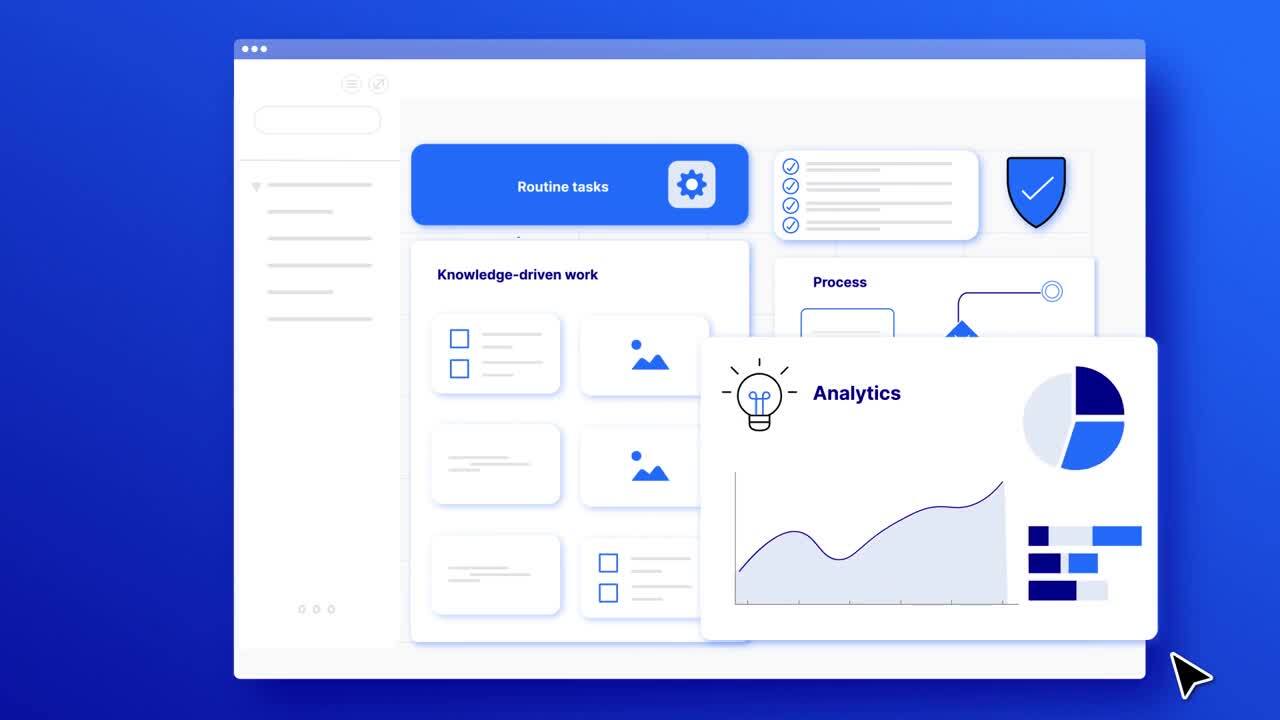
How OpenText Process Automation can benefit business
Discover the advantages of using OpenText Process Automation.
-

Speed application development
Create applications quickly and at a lower cost with low-code, drag-and-drop modeling, reusable building blocks and accelerators.
-

Deliver streamlined, intuitive user experiences
Successfully deliver a dynamic, relevant customer experience with smart, content-rich applications designed for modern work.
-

Integrate enterprise information
Seamlessly connect and orchestrate information flows across lead applications and other systems from within business applications.
-

Gain real-time business insight
Leverage pre-built, customizable reports that eliminate the complex task of building, deploying and using a business intelligence tool.
-

Increase developer agility
Enable developers and business experts to collaboratively work on applications, speeding development cycles and accelerating time to value.
-

Flexible deployment
Run anywhere and accelerate the deployment of new features with cloud-native software that offers the choice to deploy on-premises, in a hybrid environment or in the cloud.
Why OpenText Process Automation?
-
Single integrated platform
Build process automation and case management applications for complex business processes with a single integrated platform.
-
Powerful user experience development tools
Put application design and development in the hands of business and technical users who understand the way people work.
-
Information-driven design
Create applications and define business processes, policies and workflows that use structured and unstructured information to focus in on desired business outcomes.
-
Breadth of services and solutions
OpenText is the leader in business content management, helping thousands of organizations with complex requirements securely capture, govern and exchange information globally.
Key features
-
Intelligent process automation
Defines, optimizes and automates repeatable business processes, integrates with RPA and intelligent document processing tools and incorporates business rules within processes to standardize operational decisions and ensure consistent execution. -
Dynamic case management
Provides knowledge workers access to the systems, content and people they need to make informed decisions and move cases forward.
-
Enterprise integration
Offers a common information layer that makes information from a variety of systems—content services platforms, capture systems, AI and more—accessible to digital process automation applications. -
Mobile application development
Utilizes a mobile-first philosophy to ensure business users can manage information and tasks anywhere, anytime and on any device.
-
Packaged applications
Fast-track business value with packaged applications focused on contract management, citizen services, bid management, opening new accounts, client servicing, claims management, and more. -
Bridge information silos
Connect content and process to the applications your teams work in every day, including SAP, Salesforce and Microsoft. Get a 360-degree view of relevant information from a single interface.
How to buy
OpenText Process Automation
| Swipe to see more |
Automate workflows ranging from simple tasks to complex processes with structured/unstructured data.
End-to-end automation  |
|---|
| Dynamic case management |
| Workflow automation |
| Service orchestration |
| Business rules management system |
Model and automate business processes effectively with intuitive tools.
| No-code/low-code |
|---|
| Pro-code |
| Ready-made process templates |
| AI-assisted development |
Achieve a competitive edge by tracking process performance for an improved cycle time and efficiency
| Self-service reporting tool |
|---|
| Out-of-box KPIs |
| Querying/listing process instances |
Add On Integration with OpenText Intelligence |
Eliminate information fragmentation across business applications with streamlined processes.
| SAP® S/4 HANA |
|---|
| SAP® SuccessFactors® |
| Salesforce® |
| Custom integrations |
Enhance processes with advanced tools to improve efficiency, productivity and compliance.
Add On Open Content Management |
Add On RPA |
Add On Digital signature |
Add On Metadata extraction and classification |
Add On On-demand document generation |
| Off cloud |
|---|
| Public cloud |
| Private cloud |
| Managed service |
Accelerate the value of OpenText Process Automation
Deployment
OpenText offers deployment choice and flexibility for OpenText Process Automation.
- Accelerate cloud strategies with OpenText cloud expertsOpenText Private Cloud (Single Tenant) on OpenText Cloud, AWS, GCP, or Azure
- Extend your teamOff cloud, on-premises software, managed by your organization or OpenText
Professional Services
OpenText Professional Services combines end-to-end solution implementation with comprehensive technology services to help improve systems.
- Get a trusted partner to guide your information management pathYour journey to success
- Propel your business into the future with modern solutionsNextGen Services
- Accelerate your information management journeyConsulting Services
- Unlock the full potential of your information management solutionCustomer Success Services
Partners
OpenText helps customers find the right solution, the right support, and the right outcome.
- Search OpenText's Partner directoryFind a Partner
- Industry-leading organizations that enhance OpenText products and solutionsStrategic Partners
- Explore OpenText's Partner solutions catalogApplication Marketplace
Training
OpenText Learning Services offers comprehensive enablement and learning programs to accelerate knowledge and skills.
- Training for various OpenText Process Automation Platform rolesOpenText Process Automation Platform training
- Meet the demands of all types of users for effective adoptionLearning Services
- Unlimited access to training with personalized tiers to fit your needsLearning Subscriptions
Communities
Explore our OpenText communities. Connect with individuals and companies to get insight and support. Get involved in the discussion.
- Explore ideas, join discussions, and networkOpenText’s forums
Premium Support
Optimize the value of your OpenText solution with dedicated experts who provide mission-critical support for your complex IT environment.
OpenText Process Automation resources


OpenText Process Automation
Read the overviewA simple guide to successful business process automation
Read the paperGain an information advantage with digital process automation
View the infographicDrive adaptability with optimized, silo-free processes powered by Business Process Automation
Read the overviewRobotic process automation
Read the white paperTransform experiences with dynamic case management
Read the ebookOpenText Process Automation
Read the overviewA simple guide to successful business process automation
Read the paperGain an information advantage with digital process automation
View the infographicDrive adaptability with optimized, silo-free processes powered by Business Process Automation
Read the overviewRobotic process automation
Read the white paperTransform experiences with dynamic case management
Read the ebookWhat’s new in OpenText Process Automation
Read the blogBusiness process automation – the secret weapon of successful businesses
Read the blogThe strategic value of low-code development
Read the blogWhat’s new in OpenText Process Automation
Read the blogBusiness process automation – the secret weapon of successful businesses
Read the blogThe strategic value of low-code development
Read the blog
OpenText Process Automation (AppWorks) for low-code application development
Watch the video
OpenText Process Automation (AppWorks) for dynamic case management
Watch the video
How Huhtamaki India is transforming its finance and accounting processes
Watch the video